


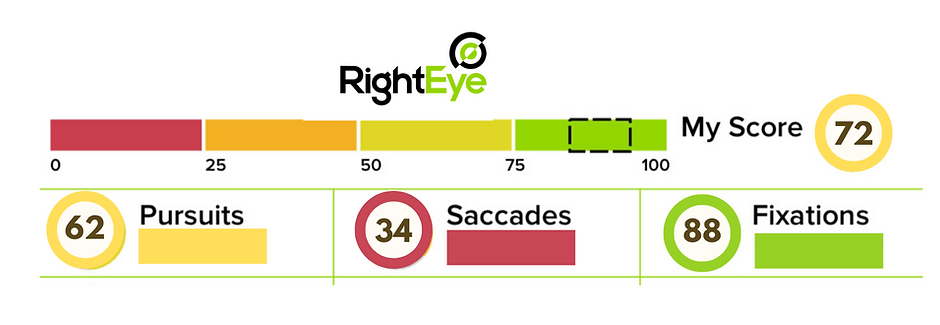
The RightEye technology is used to measure how efficiently you can fixated on a spot, move your eyes quickly between two spots, smoothly follow an object and make a decision about what you see.
This is not a vision test for us. The technology is used to see how your Brain is working. This information is part of your evaluation and helps determine how we are going to adjust you.
The RightEye also provides objective data that can be tracked over time to monitor your health.
UPPER BRAIN dampens LOWER BRAIN
FIXATIONS - Brainstem (Lower Brain)
- It all starts in your Lower Brain. Centers that are related to Primitive Reflexes, Eye Muscles and Cranial Nerves are located in this area. Being able to fixate on a spot is the first step in moving your eyes and building your Brain. If you have trouble fixating on a spot, this could be an indication that your neural pathway aren't working properly or have not developed yet.
SACCADES - Frontal Lobe (Upper Brain)
- Once we develop the ability to fixate our eyes, we will begin to look quickly from one object to another. This type of movement is called a Saccade and is primarily controlled by the Frontal Lobe of the Brain.
The Frontal Lobe has multiple functions; Initiate and execute voluntary muscle movements. Send motor information down through the spinal cord and out to skeletal muscles to tell them to move. Plan and coordinate movements. Plan, control and execute eye movements. Stimulate the muscles that produce speech and form words. We need this area of our Brain to develop for many reasons, especially the ability to inhibit. Healthy people develop and continue to have Top / Down control for the longest time.
Pursuits - PARIETAL LOBE (UPPER BRAIN)
- Now that we can fixate and then move quickly from one object to another, we now develop the ability to follow an object as it moves. This smooth eye movement is called a Pursuit. It is primarily controlled by the Parietal Lobe of the Brain.
The Parietal Lobe is involved in making us consciously aware of sensations such as touch, pain, pressure, temperature, vibration, etc. The Parietal Lobe also plays a key role in processing and analyzing sensory information to provide meaning and understanding to the stimulus. The Parietal Lobe is involved in taking information from the body and create the Brain's map of the body.
Tracking RightEye results over time gives us objective data to show improvement in your Health.
